Healthy Ageing and Physical Function
By Darryl Edwards | Last evidence review: 29 August 2026
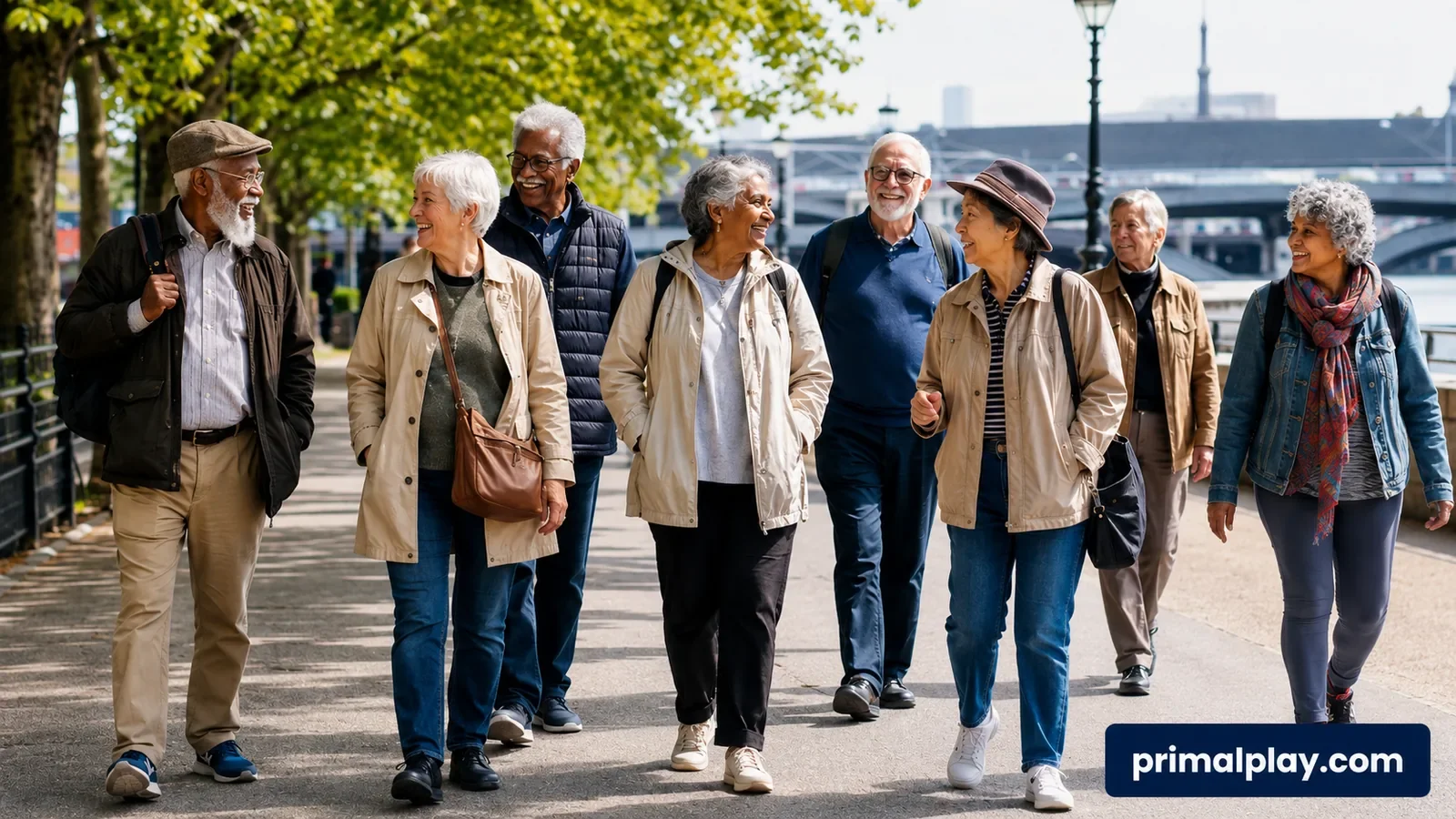
What do you want to still able to do at 70, 80 or 90?
Healthy ageing involves maintaining the physical and mental capacity to keep doing what matters to you. Physical activity can support this by preserving or improving strength, power, balance, mobility, cardiorespiratory fitness and physical function across later life.
Get up from the floor.
Carry your shopping.
Climb stairs.
Travel independently.
Play with grandchildren.
Walk uphill.
React quickly enough to catch yourself when you stumble.
Healthy ageing becomes easier to understand when you connect physical capacity with the things you want to keep doing.
The World Health Organization defines healthy ageing as developing and maintaining the functional ability that enables wellbeing in older age. Functional ability includes the capabilities that allow people to be and do what they value.[1]
Your age alone does not determine that ability.
People of the same chronological age can have very different levels of physical and mental capacity. Health conditions, physical activity, injury, medication, nutrition, environment and social circumstances all influence how function changes across later life.[1]
Capacity is what your body can do. Function is how that capacity translates into everyday life.
Strength may help you stand up from a chair. Power may help you rise quickly or respond when you stumble. Balance may help you remain upright when something unexpected happens. Cardiorespiratory fitness influences how long you can keep going.
Healthy ageing depends on how these capacities combine.
What happens to physical function as we age?
Ageing can affect skeletal muscle, neuromuscular function, aerobic capacity, balance, bone health and recovery.
The trajectory varies widely between people.
Physical inactivity and periods of illness can contribute to deconditioning. Reduced capacity can then make daily movement harder, which may further reduce activity.
Physical activity can help preserve or improve function even in later life. The updated UK Chief Medical Officers' guidance states that physical activity contributes to improved physical function, independent living and quality of life in healthy and frail older adults.[2]
The practical goal is therefore straightforward:
Maintain enough physical capacity for the life you want to live, and where possible build a reserve above those demands.
Six physical capacities that matter for healthy ageing
1. Strength
Can you produce enough force to do what daily life requires?
Standing from a chair, climbing stairs, lifting luggage, carrying shopping and getting up from the floor all require muscular strength.
Resistance training provides a direct stimulus for maintaining or improving strength.
Systematic-review evidence shows that older adults, including very old adults, can improve muscular strength through resistance training.[3,4]
Recent evidence in older women with sarcopenia also found improvements in grip strength, knee-extension strength, gait speed, Timed Up and Go performance and chair-stand performance following resistance training.[5]
What strength training can look like
Chair rises
Squats or modified squats
Step-ups
Loaded carries (weighted vest, backpack, piggy-back)
Pushing and pulling
Resistance bands
Free weights
Resistance machines
Appropriate bodyweight exercises
The exercise itself is only part of the prescription.
The resistance must provide enough stimulus to create adaptation while remaining appropriate to the individual.
2. Power
Can you produce force quickly when you need it?
Strength describes how much force you can produce.
Power adds speed.
Many everyday tasks require both.
Rising rapidly from a chair, climbing stairs, responding to a loss of balance and moving quickly around an obstacle all involve producing force within limited time.
Research across older populations shows a consistent association between muscle power and physical function. A systematic review of 44 studies found that muscle power was positively associated with physical-function measures and may be slightly more closely related to function than strength alone.[6]
Power training usually involves attempting the lifting or pushing phase of a resistance exercise quickly while maintaining control.
A 2022 systematic review and meta-analysis found a modest advantage for power training over traditional strength training for physical function in older adults. A later 2023 review found broadly similar functional outcomes overall, with uncertainty varying by functional test.[7,8]
This supports a practical conclusion:
Older adults need strength. Some also benefit from training the ability to express that strength quickly.
Power training might include
Fast but controlled sit-to-stands
Rapid step-ups
Medicine-ball throws
Sled pushes
Kettlebell swings
Jumping
Primal Play Method® Shoulder barges
Loaded movements performed with intentional speed
Power work requires appropriate progression.
People with significant frailty, uncontrolled cardiovascular symptoms, recent surgery, substantial falls risk or other clinical concerns may require professional assessment and supervision.
3. Balance
What happens when movement becomes unexpected?
Balance is required when you stand still, move, turn, reach, step, carry or respond to a disturbance.
Falls prevention provides some of the strongest evidence for training balance and function in older adults.
A major Cochrane review including 108 randomised trials found that exercise reduced the rate of falls by approximately 23% in community-dwelling older adults. Balance and functional exercises reduced fall rates by approximately 24%.[9]
Multicomponent programmes combining balance and functional exercise with resistance training also probably reduce falls.[9]
Balance can be challenged by changing:
Base of support
Direction
Speed
Reaching distance
Visual information
Surface
Stepping demands
Movement unpredictability
Simultaneous cognitive tasks
Balance training needs challenge to drive adaptation.
The appropriate level is the point where the person must work to maintain control without creating unacceptable risk.
4. Mobility
Can you move through the positions life requires?
Mobility involves more than flexibility.
Walking, turning, reaching, getting onto the floor, standing again and stepping around obstacles require combinations of:
joint range
strength
balance
coordination
control
confidence
Reduced mobility can result from many causes, including osteoarthritis, pain, neurological conditions, previous injury, weakness and fear of falling.
A useful movement prescription therefore addresses the limiting factor rather than treating mobility as one generic quality.
5. Cardiorespiratory fitness
How long can you keep moving before your capacity becomes the limiting factor?
Cardiorespiratory fitness influences walking, climbing stairs, travelling, recreational activity and the ability to tolerate sustained physical effort.
Across large bodies of evidence, higher cardiorespiratory fitness is consistently associated with lower risks of morbidity and mortality. An overview of meta-analyses representing more than 20 million observations concluded that cardiorespiratory fitness is a strong and consistent predictor of health outcomes.[10]
The updated UK physical activity guidelines recommend that adults aged 65 years and over aim to accumulate at least 150 minutes of moderate-intensity aerobic activity each week. Regularly active older adults may obtain comparable benefits from 75 minutes of vigorous activity or a combination of moderate and vigorous activity.[2]
Walking, cycling, swimming, dancing, games and other activities can all contribute when they provide an appropriate cardiovascular stimulus.
6. Coordination and cognitive-motor function
Can you move while your brain is solving another problem?
Real life rarely involves one physical task at a time.
You may need to walk while talking.
Carry something while navigating stairs.
Watch traffic while changing direction.
React to an obstacle.
These situations combine movement with perception, attention and decision-making.
A 2024 systematic review and meta-analysis found that dual-task training may improve balance in healthy older adults.[11]
This creates a practical role for movement involving:
reaction
decision-making
visual scanning
coordination
task switching
changing rules
responding to another person
The cognitive challenge should complement the physical goal rather than overwhelm it.
Why strength and power deserve special attention
Public-health messaging has historically placed considerable emphasis on aerobic exercise.
Physical function requires more.
The 2026 UK Chief Medical Officers' guidance states that older adults should undertake activities aimed at maintaining or improving muscle strength, balance and flexibility on at least two days each week.[2]
Strength creates the ability to produce force.
Power influences how rapidly that force becomes available.
Together, they contribute to tasks such as:
standing from a chair
climbing stairs
lifting
carrying
recovering from perturbations (sudden, unexpected change in balance)
moving quickly when circumstances demand it
The aim is functional reserve.
You want everyday tasks to use only part of your available capacity.
What is sarcopenia?
Sarcopenia is a progressive skeletal-muscle disorder associated with impaired physical function and adverse health outcomes.
The European Working Group on Sarcopenia in Older People revised its consensus definition to place low muscle strength at the centre of clinical identification.[12]
Under EWGSOP2:
Low muscle strength indicates probable sarcopenia.
Low muscle quantity or quality confirms the diagnosis.
Poor physical performance indicates severe sarcopenia.[12]
This matters because muscle function contributes to mobility, recovery from illness, balance, independence and everyday physical capacity.
People experiencing unexplained weakness, muscle loss, repeated falls or declining function should seek appropriate clinical assessment rather than self-diagnosing sarcopenia.
Falls are not simply an inevitable part of ageing
Falls risk increases with age, but several contributing factors are modifiable. Exercise is one of them.
The Cochrane evidence is substantial:
Multicomponent exercise, including balance, functional, and resistance activity, probably also reduces falls.[9]
This means balance training should involve more than occasional standing on one leg.
It should progressively challenge the systems required to respond to real movement demands.
What type of exercise is best for healthy ageing?
No single exercise type addresses every component of physical function.
A multicomponent approach is usually more appropriate.
That may combine:
aerobic activity
resistance training
power
balance
mobility
functional movement
coordination
A 2024 meta-analysis found that multicomponent exercise improved frailty status and physical-function measures, including muscle strength, gait speed, balance, SPPB, and Timed Up and Go, in frail older adults.[13]
A large 2023 meta-analysis and systematic review involving 105 studies and 7,759 participants also found exercise improved overall physical function in older adults.[14]
The right programme therefore starts with the question:
What capacity needs to improve?
WHY → HOW → WHAT → DOSE → REPEAT
A useful exercise prescription needs more than a list of exercises.
WHY
What outcome matters?
Walking further?
Getting off the floor?
Reducing falls risk?
Preserving strength?
Improving aerobic capacity?
HOW
What conditions make participation achievable and engaging?
WHAT
Which movement provides the required stimulus?
DOSE
How much intensity, volume, frequency and recovery are appropriate?
REPEAT
Can the activity be repeated long enough for adaptation to occur?
Population guidelines provide direction.
Individual exercise prescription answers these questions.
| Component | General recommendation |
|---|---|
| Daily movement | Participate in physical activity every day |
| Aerobic activity | Aim for at least 150 minutes of moderate-intensity activity per week |
| Vigorous activity | Regularly active adults can use 75 minutes of vigorous activity, or a combination of moderate and vigorous activity |
| Strength, balance and flexibility | Include activities aimed at maintaining or improving these capacities on at least 2 days per week |
| Sedentary behaviour | Break up prolonged sedentary periods with light activity where physically possible |
Some activity is better than none.
The 2026 guidance explicitly emphasises that even light activity provides benefits compared with remaining sedentary and that people can build gradually from their current level.[2]
Population guidelines provide a target. Exercise prescription starts with the individual.
Healthy ageing with long-term conditions
Living with a long-term condition does not automatically remove the potential benefits of movement.
It changes the clinical reasoning.
Pain, fatigue, neurological symptoms, cardiovascular disease, arthritis, cancer treatment, cognitive decline and other conditions may affect:
movement choice
intensity
volume
balance challenge
recovery
progression
supervision requirements
WHO physical activity recommendations include older adults and people living with chronic conditions and disability.[15]
UK guidance also states that for older adults with frailty, moderate-to-severe dementia, regular falls, or a vertebral-fracture history, new exercise may be more appropriately initiated under trained professional supervision.[2]
For some people, the starting point may be several minutes of walking.
For another, it may be repeated chair rises.
For another, it may involve structured resistance and power training.
Progress from current capacity.
For healthcare and exercise professionals: assess current function, symptoms, goals and relevant risks before selecting WHAT and DOSE. Diagnosis informs the prescription, while functional capacity often determines the practical starting point.
Healthcare professionals supporting an older adult who may benefit from personalised movement coaching can review Darryl’s healthcare referral and signposting information.
Can movement be playful in later life?
Playful movement can still provide meaningful physical challenges.
An activity may include:
partner challenges
reaction games
ball activities
carrying
reaching
stepping
decision-making
coordination
modified competition
movement exploration
The physiological requirement remains.
Strength training still needs enough resistance to stimulate strength adaptation.
Power training needs an appropriate intent to produce force quickly.
Balance training needs sufficient challenge to postural control.
Aerobic activity needs enough intensity and duration to train cardiorespiratory fitness.
Play changes the experience and delivery of movement.
It does not remove the principles of exercise physiology.
How the Primal Play Method® approaches healthy ageing
The Primal Play Method® combines exercise medicine principles with active play to help shape movement around the individual.
The goal starts with function.
Someone may need greater lower-body strength.
Another person may need power to rise or step more quickly.
Another may benefit from balance, coordination or aerobic capacity.
What Does the Primal Play Method® Feel Like for Older Adults?
The Method asks:
WHY → HOW → WHAT → DOSE → REPEAT
The physical stimulus remains specific to the goal.
The experience can include choice, challenge, feedback, exploration and social interaction.
For example, a strength goal might involve loaded carries, partner resistance or repeated rising tasks.
A power goal might use rapid but controlled sit-to-stand challenges, throws or quick resisted movements.
Balance and coordination might involve reaction games, directional changes or partner tasks.
The objective remains measurable physical adaptation.
The delivery can remain playful.
Evidence supports the underlying exercise components described on this page. Evidence specifically evaluating the Primal Play Method® in older adults should be considered separately from that underlying evidence.
How can physical function be measured?
Physical function can be assessed rather than guessed.
Common measures include:
Grip strength
Used in sarcopenia assessment.
Chair-stand tests
Provide information about lower-body strength and functional performance.
Timed Up and Go
Assesses functional mobility.
Short Physical Performance Battery
Combines gait, balance and chair-rise performance.
Gait speed
Provides a useful measure of mobility and physical performance.
Six-minute walk test
Measures functional exercise capacity.
EWGSOP2 identifies grip strength and chair-stand testing for strength assessment and includes gait speed, SPPB, Timed Up and Go and 400-m walking tests among measures of physical performance.[12]
No single test defines healthy ageing.
Measurement helps establish a baseline, identify limitations and track change.
Healthy ageing starts before old age.
Physical capacity develops across the lifespan.
Strength, power, cardiorespiratory fitness, balance and coordination do not suddenly become relevant at 65.
Maintaining them earlier can create greater physical reserve for later life.
Starting later still matters.
Older adults can improve strength and physical function through appropriately prescribed exercise, including people who begin from low levels of activity.[2,3]
The useful question at any age is:
What capacity can you build today that you want available tomorrow?
Frequently asked questions
What is healthy ageing?
Healthy ageing is the process of developing and maintaining the functional ability that enables wellbeing in older age, according to the World Health Organization.[1]
What is physical function?
Physical function describes your ability to perform physical tasks. It depends on capacities including strength, power, balance, mobility, coordination and cardiorespiratory fitness.
Is strength or power more important as we age?
Both matter. Strength describes force-production capacity. Power describes how quickly force can be produced. Muscle power is strongly associated with physical function, but current evidence does not establish that power training should universally replace traditional resistance training.[6-8]
Can older adults improve strength?
Yes. Resistance training improves strength in older adults, including very old adults, when appropriately prescribed and progressed.[3]
Can exercise reduce falls?
Yes. High-certainty Cochrane evidence shows that exercise reduces falls in community-dwelling older adults. Balance and functional exercise have particularly strong evidence.[9]
Is walking enough for healthy ageing?
Walking can support aerobic fitness, mobility and general physical activity. It usually provides an incomplete stimulus for strength and balance. UK guidance therefore recommends strength, balance and flexibility alongside aerobic physical activity.[2]
How often should older adults do strength and balance activities?
UK guidance recommends activities aimed at maintaining or improving muscle strength, balance and flexibility on at least two days each week.[2]
Can playful movement support healthy ageing?
Playful movement can deliver physical, cognitive and social challenges when appropriately designed. The stimulus still needs to match the intended outcome, such as strength, power, balance or aerobic fitness.
References
World Health Organization. (2020, October 26). Healthy ageing and functional ability. WHO. https://www.who.int/news-room/questions-and-answers/item/healthy-ageing-and-functional-ability
UK Chief Medical Officers. UK Chief Medical Officers' Physical Activity Guidelines. Department of Health and Social Care; 2026. Updated July 10, 2026. https://www.gov.uk/government/publications/physical-activity-guidelines-uk-chief-medical-officers-report
Grgic J, Garofolini A, Orazem J, Sabol F, et al. (2020). Effects of resistance training on muscle size and strength in very elderly adults: a systematic review and meta-analysis of randomized controlled trials. Sports Medicine, 50(11), 1983–1999. https://doi.org/10.1007/s40279-020-01331-7
Khodadad Kashi S, Mirzazadeh ZS, Saatchian V. (2023). A systematic review and meta-analysis of resistance training on quality of life, depression, muscle strength, and functional exercise capacity in older adults aged 60 years or more. Biological Research For Nursing, 25(1), 88–106. https://doi.org/10.1177/10998004221120945
Zhou Y, Wen K, Zhang X, Sun Y. (2026). Effects of resistance training on muscle mass, strength, and physical function in older women with sarcopenia: a systematic review and meta-analysis. Frontiers in Public Health, 13, 1735899. https://doi.org/10.3389/fpubh.2025.1735899
Byrne C, Faure C, Keene DJ, Lamb SE. (2016). Ageing, muscle power and physical function: a systematic review and implications for pragmatic training interventions. Sports Medicine, 46(9), 1311–1332. https://doi.org/10.1007/s40279-016-0489-x
Balachandran AT, Steele J, Angielczyk D, Belio M, et al. (2022). Comparison of power training vs traditional strength training on physical function in older adults: a systematic review and meta-analysis. JAMA Network Open, 5(5), e2211623. https://doi.org/10.1001/jamanetworkopen.2022.11623
Morrison RT, Taylor S, Buckley J, Twist C, Kite C. (2023). High-velocity power training has similar effects to traditional resistance training for functional performance in older adults: a systematic review. Journal of Physiotherapy, 69(3), 148–159. https://doi.org/10.1016/j.jphys.2023.05.018
Sherrington C, Fairhall NJ, Wallbank GK, Tiedemann A, et al. (2019). Exercise for preventing falls in older people living in the community. Cochrane Database of Systematic Reviews, (1), CD012424. https://doi.org/10.1002/14651858.CD012424.pub2
Lang JJ, Prince SA, Merucci K, Cadenas-Sanchez C, et al. (2024). Cardiorespiratory fitness is a strong and consistent predictor of morbidity and mortality among adults: an overview of meta-analyses representing over 20.9 million observations from 199 unique cohort studies. British Journal of Sports Medicine, 58(10), 556–566. https://doi.org/10.1136/bjsports-2023-107849
Ercan Yildiz S, Fidan O, Gulsen C, Colak E, et al. (2024). Effect of dual-task training on balance in older adults: a systematic review and meta-analysis. Archives of Gerontology and Geriatrics, 121, 105368. https://doi.org/10.1016/j.archger.2024.105368
Cruz-Jentoft AJ, Bahat G, Bauer J, Boirie Y, et al. (2019). Sarcopenia: revised European consensus on definition and diagnosis. Age and Ageing, 48(1), 16–31. https://doi.org/10.1093/ageing/afy169
Yang X, Li S, Xu L, Liu H, et al. (2024). Effects of multicomponent exercise on frailty status and physical function in frail older adults: a meta-analysis and systematic review. Experimental Gerontology, 197, 112604. https://doi.org/10.1016/j.exger.2024.112604
Valenzuela PL, Saco-Ledo G, Morales JS, Gallardo-Gómez D, et al. (2023). Effects of physical exercise on physical function in older adults in residential care: a systematic review and network meta-analysis of randomised controlled trials. The Lancet Healthy Longevity, 4(6), e247–e256. https://doi.org/10.1016/S2666-7568(23)00057-0
World Health Organization. (2020). WHO guidelines on physical activity and sedentary behaviour. World Health Organization. https://www.who.int/publications/i/item/9789240015128