Movement Is Medicine: How Physical Activity Supports Health and Function
Last evidence review: 24 August 2026
Movement can influence health in measurable ways.
Regular physical activity can improve cardiorespiratory fitness, muscular strength, physical function, metabolic health, mental health and aspects of cognitive function. Higher levels of physical activity are also associated with lower risks of premature death, cardiovascular disease, type 2 diabetes and several cancers.[1–5]
This is the basis of movement as medicine.
The phrase does not mean that movement replaces medical treatment. It describes using physical activity and exercise as evidence-based tools for prevention, health promotion, physical function, and, where appropriate, support in managing long-term conditions.
The important questions are not simply whether movement is beneficial.
They are:
What movement? How much? For whom? For what outcome? And can it be repeated consistently enough to create adaptation?
That is where exercise medicine begins.
What does “movement is medicine” mean?
Exercise medicine applies knowledge from exercise science and clinical practice to the use of physical activity for health.
Movement creates a physiological stimulus. The body responds to that stimulus based on factors including the type of activity, intensity, duration, frequency, recovery, and the health and physical capacity of the person performing it.
Different forms of movement produce different adaptations.
Aerobic activity can improve cardiorespiratory fitness and cardiovascular and metabolic health.
Resistance exercise can increase strength and support muscle, bone and physical function.
Balance and multicomponent activities become increasingly important for maintaining function and reducing falls risk as we age.
Movement can also affect brain and mental health.
A 2025 umbrella review encompassing 133 systematic reviews, 2,724 randomised controlled trials and more than 258,000 participants found beneficial effects of exercise on general cognition, memory and executive function.[6]
Physical activity interventions have also been shown to reduce symptoms of depression and anxiety across diverse adult populations, although the quality and characteristics of the underlying evidence vary.[7]
The effects of movement are broad. The prescription still needs to match the person and the desired outcome.
The biggest benefits may begin before you reach the guidelines.
Physical activity has a dose-response relationship with many health outcomes.
A large 2023 meta-analysis covering 94 prospective cohorts and more than 30 million participants found that higher levels of non-occupational physical activity were associated with lower risks of premature mortality, cardiovascular disease and several cancers.[2]
One of its most useful findings was that the relationship was not linear.
The largest relative differences in risk occurred when people moved from very little activity to greater amounts. At the equivalent of about 150 minutes of moderate-to-vigorous aerobic physical activity per week, the analysis estimated a 31% lower relative risk of all-cause mortality than inactivity.[2]
Even around half of that activity level was associated with substantial differences in risk.
This matters because the first goal for an inactive person does not have to be athletic performance.
It may be simply moving more than before.
The largest gains often start with moving from inactive to more active.
A 2023 dose-response meta-analysis found substantial reductions in mortality risk below the full recommended physical activity dose, with further benefits as activity increased.[2]
How much physical activity do we need?
For adults, the World Health Organization recommends:
150–300 minutes of moderate-intensity aerobic physical activity each week, or 75–150 minutes of vigorous-intensity activity, or an equivalent combination.
Adults should also perform muscle-strengthening activity involving the major muscle groups on at least two days each week.[1]
Adults: aim for aerobic activity plus strength.
WHO recommends 150–300 minutes of moderate-intensity aerobic activity per week, or 75–150 minutes of vigorous-intensity activity, plus muscle-strengthening activities involving the major muscle groups on at least two days each week.[1]
UK Chief Medical Officers give broadly similar recommendations and emphasise that adults should be active every day, strengthen major muscle groups at least twice weekly and reduce prolonged sedentary time.[8]
For older adults, balance and multicomponent physical activity become particularly important alongside aerobic and strengthening activity.[1]
These guidelines provide population-level targets.
They are not pass-or-fail thresholds.
WHO explicitly recognises that some activity is better than none and recommends gradually increasing frequency, intensity and duration when people are currently inactive.[1]
Strength matters too
Movement medicine cannot be reduced to cardio.
Muscle strength contributes to mobility, physical function, metabolic health and our ability to perform everyday tasks.
A systematic review and meta-analysis of prospective cohort studies found that participation in muscle-strengthening activity was associated with lower risks of all-cause mortality and several major non-communicable diseases. Combining aerobic and muscle-strengthening activity was associated with lower mortality than performing neither.[4]
This is why modern physical activity guidelines include both aerobic and strengthening recommendations.
Walking matters.
Strength matters.
Balance matters.
Movement variety matters.
The appropriate combination changes with age, health, goals, and physical capacity.
Sitting less also matters.
Exercise sessions represent only part of the day.
Sedentary behaviour is characterised by low-energy waking behaviour performed while sitting, reclining or lying.
Device-measured research has found a dose-response relationship between higher physical activity, lower sedentary time and lower all-cause mortality in middle-aged and older adults.[3]
WHO therefore recommends limiting sedentary time and replacing it with physical activity of any intensity where possible.[1]
This creates another useful principle:
Movement does not have to happen only during a workout.
Walking to the shops, taking stairs, moving around the workplace, gardening, playing, cycling, carrying, standing up regularly and other everyday physical activities can all contribute to total movement.
Movement provides the stimulus. Repetition creates adaptation.
A single bout of physical activity can produce short-term (acute) physiological responses.
Longer-term changes in fitness, strength, function and many health outcomes require repeated exposure.
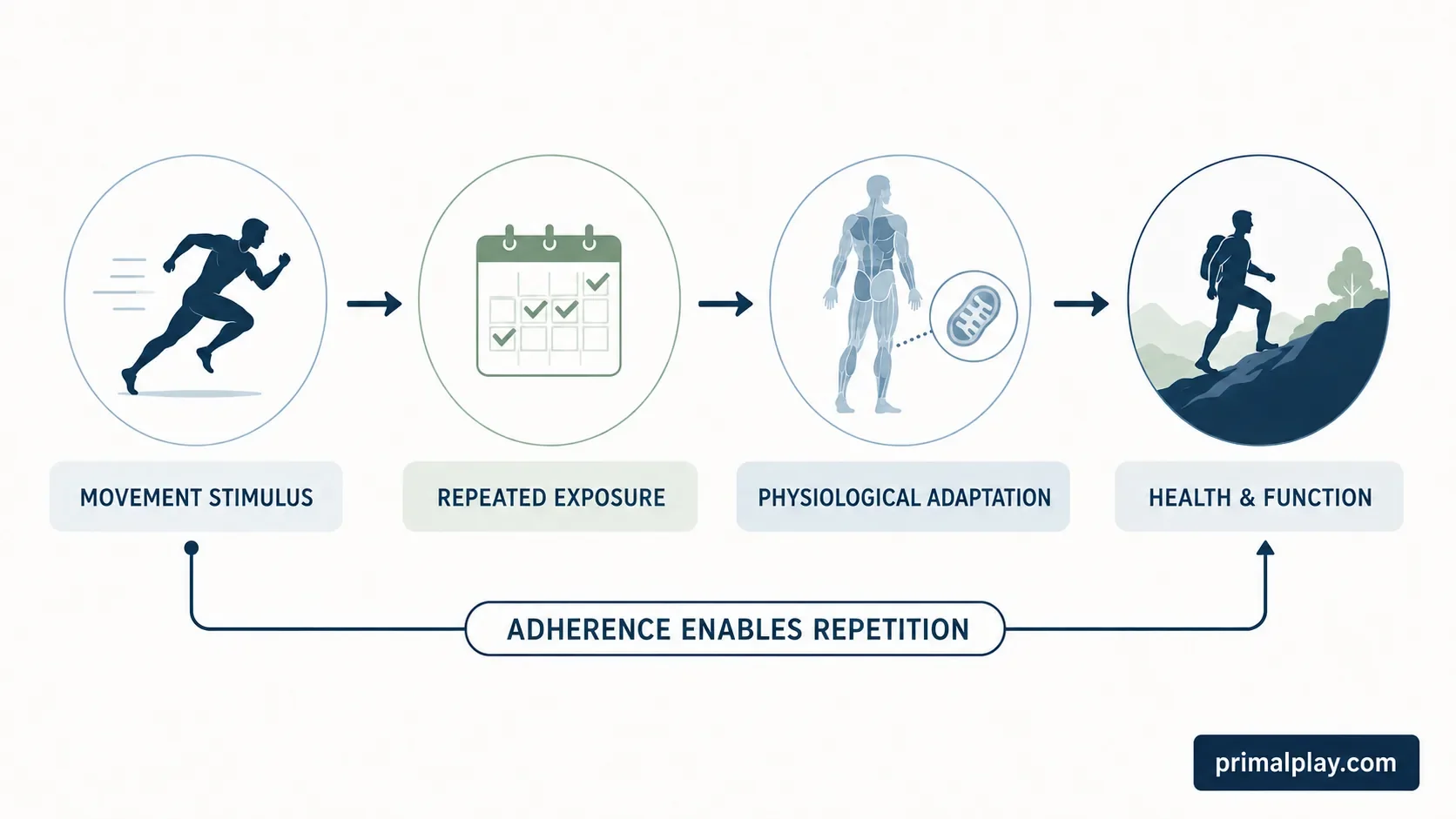
Movement creates the stimulus. Adherence enables repetition. Repeated exposure supports physiological adaptation and health and function.
This creates an important distinction between knowing that exercise works and actually receiving enough of the stimulus to benefit.
An exercise programme can be well designed on paper and still achieve little if it is rarely performed.
For this reason, I think about movement through five questions:
WHY
What health, function or life outcome matters to you?
HOW
What conditions make participation realistic, engaging and achievable?
WHAT
What type of movement is appropriate for the goal?
DOSE
How much frequency, intensity, time and volume are needed to provide an appropriate stimulus?
REPEAT
Can the activity be continued, adapted when circumstances change and restarted after interruptions?
The five questions connect exercise science with the practical realities of participation. The appropriate movement stimulus matters, and so does whether it can be repeated consistently enough to support adaptation. The final question is where physical activity adherence becomes central to exercise medicine.
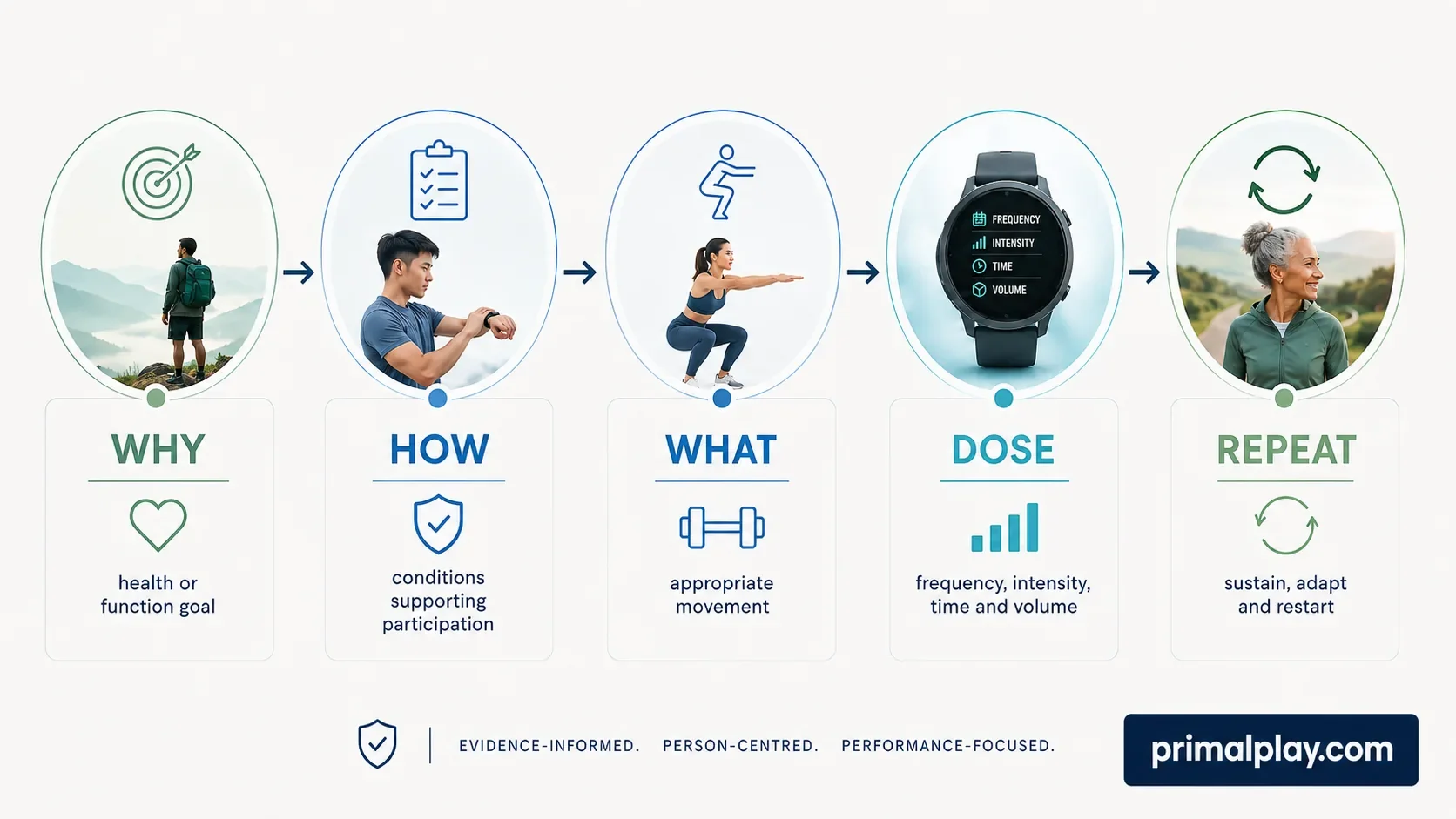
The Primal Play Method® framework connects movement goals, participation, appropriate activity, dose and repeatability.
Why adherence matters
The biological effectiveness of exercise and the behavioural reality of doing it cannot be separated.
A person needs sufficient movement exposure for many adaptations to develop.
Yet knowledge of health benefits does not guarantee participation.
Enjoyment, autonomy, competence, confidence, social connection, perceived capability, access, previous experience and the environment can all influence movement behaviour.
This is one reason my work combines exercise science with the psychology and experience of movement.
The question becomes:
How do we create an appropriate movement stimulus that someone is willing and able to repeat?
This is also where the [Primal Play Method® → /what-is-primal-play] fits within movement as medicine.
Where does active play fit?
Play does not replace exercise physiology.
It changes the experience through which movement can occur.
The Primal Play Method® draws on exercise physiology, cognitive neuroscience, evolutionary biology and play psychology to create movement experiences that can include choice, challenge, feedback, curiosity, competence and social connection.
Playful movement can still involve meaningful physical work.
People can run, jump, carry, crawl, balance, throw, react, change direction, lift and solve movement challenges while developing strength, fitness, coordination and physical confidence.
The physiological stimulus still matters.
So does whether someone wants to return and do it again.
Movement provides the stimulus. Adherence enables repetition. Repetition supports adaptation.
Movement across the lifespan
The role of movement changes throughout life.
Children and young people
Movement and active play contribute to physical development, movement skills, muscular fitness, bone health and opportunities for social and cognitive development.
UK guidance recommends varied physical activity across the week for children and young people and specifically recognises play as one way activity can occur.[8]
Adults
Movement can help maintain cardiorespiratory fitness, strength, metabolic health, physical function and mental wellbeing.
Work, caring responsibilities and prolonged sitting can make structured exercise difficult, which makes both planned exercise and everyday movement relevant.
Older adults
Maintaining strength, aerobic capacity, balance and mobility becomes increasingly important for preserving physical function and independence.
WHO recommends multicomponent activity emphasising functional balance and strength on three or more days each week for older adults, in addition to aerobic and muscle-strengthening activity.[1]
Age changes the prescription.
It does not remove the need for movement.
Movement and brain health
The brain responds to physical activity as well as the body.
Evidence from randomised trials indicates that exercise can improve general cognition, memory, and executive function across populations.[6]
The size of the effect varies by population, exercise modality, and cognitive outcome.
This makes movement relevant to healthy ageing, learning, attention and cognitive health while requiring care around exaggerated claims such as exercise “supercharging” the brain.
Movement is one influence on cognitive health among many.
It is also one we can act on.
Movement and mental health
Physical activity can support mental health.
An umbrella review of 97 systematic reviews, covering more than 1,000 randomised controlled trials, found beneficial effects of physical activity interventions on symptoms of depression, anxiety and psychological distress.[7]
The evidence varied in quality, population and intervention design.
Movement should therefore be viewed as part of the range of approaches that can support mental health rather than as a universal replacement for psychological or medical care.
The practical value is considerable.
Movement can provide physical stimulus while also creating opportunities for mastery, autonomy, social connection and positive experiences.
Movement and long-term conditions
Exercise medicine becomes especially important when health circumstances change.
Regular physical activity is recommended for many people living with chronic conditions. However, the appropriate type and dose may require adaptation around symptoms, medications, treatment, fatigue, pain, mobility and functional limitations.[1]
WHO guidance recognises this explicitly. People who cannot meet general recommendations should be active according to their abilities and may benefit from advice from an appropriately qualified healthcare or physical activity professional.[1]
Healthcare professionals considering personalised movement coaching for an adult with long-term health or functional needs can review Darryl’s healthcare referrals and signposting pathway.
The principle remains the same:
The movement should fit the person.
The prescription may need to change.
Movement and cancer
Exercise oncology provides one of the clearest examples of movement being applied alongside medical treatment.
International consensus guidance concludes that exercise training is generally safe for cancer survivors when appropriately prescribed and adapted. Evidence supports aerobic and resistance exercise for outcomes including physical function, cancer-related fatigue and health-related quality of life.[5]
Cancer type, treatment, symptoms, bone health, blood counts, cardiovascular considerations, neuropathy, fatigue and other factors may alter the appropriate prescription.
This is why cancer exercise requires individual clinical context rather than generic fitness advice.
Darryl's specialist [Movement Oncology™ and exercise oncology support → /exercise-oncology] applies this principle before, during and after cancer treatment.
Movement is medicine. Dose still matters.
“Movement is medicine” should never mean that every movement produces every health outcome.
Medicine depends on an appropriate intervention.
Exercise does too.
A gentle walk and progressive resistance training provide different stimuli.
Balance training and interval cycling solve different physical problems.
Ten minutes and ten hours are different doses.
A healthy 25-year-old and an older adult recovering from cancer treatment may need very different prescriptions.
The useful question is not:
Is movement good for you?
The evidence already answers that broadly.
The better question is:
What movement, at what dose, for this person, for this goal, and how can it be repeated consistently enough to matter?
That is movement as medicine.
From evidence to action
The evidence supporting physical activity is extensive, but important questions remain about optimal dose, individual response, adherence, and how best to translate guidelines into daily life.
My work focuses on that translation.
Exercise science helps identify the stimulus.
Exercise medicine helps match that stimulus to health and function.
Behavioural science helps us understand participation.
Play can change the experience of movement.
Together, they create a more useful question than simply asking whether someone exercises:
What movement can this person do, benefit from and keep returning to?
Explore the Exercise Science Research
Discover the Primal Play Method®
Learn about Movement Oncology™
Meet Darryl Edwards
Frequently Asked Questions
What does “movement is medicine” mean?
Movement is medicine describes the evidence-informed use of physical activity and exercise to support health, fitness, physical function, disease prevention and, where appropriate, management of long-term conditions. Movement complements medical care when clinical treatment is required.
Is physical activity the same as exercise?
Physical activity includes bodily movement that increases energy expenditure, including walking, active travel, work, household activity, play and sport. Exercise is a planned, structured form of physical activity usually performed to improve or maintain fitness, health or function.
How much physical activity should adults do?
WHO recommends 150–300 minutes of moderate-intensity aerobic activity each week, or 75–150 minutes of vigorous activity, or an equivalent combination. Muscle-strengthening activity involving the major muscle groups is recommended on at least two days each week.[1]
Is walking enough?
Walking can provide significant health benefits, particularly when it replaces inactivity and is performed regularly. Whether walking alone provides enough stimulus depends on the individual's goals, intensity and physical capacity. Strength, balance and other forms of movement provide benefits that walking may not fully address.
Why is strength training important?
Resistance and other muscle-strengthening activities help maintain or improve muscular strength and physical function. Current WHO and UK guidelines recommend muscle-strengthening activity at least twice weekly for adults.[1,8]
Does every exercise need to be intense?
No. Physical activity at different intensities can contribute to health. The appropriate intensity depends on the goal, person and context. WHO emphasises that some physical activity is better than none and recommends gradual progression for inactive people.[1]
Can people with long-term conditions exercise?
Many can and are encouraged to be physically active. Activity may need to be adapted to the condition, symptoms, treatment, medication, functional capacity, and clinical advice. Some people should seek professional guidance before increasing their exercise dose.[1]
Where does play fit into exercise medicine?
Play can provide a context for physically meaningful movement while introducing choice, challenge, enjoyment, feedback and social connection. Within the Primal Play Method®, playful movement is used alongside exercise-science principles rather than as a substitute for appropriate exercise dose or clinical guidance.
References
World Health Organization. WHO guidelines on physical activity and sedentary behaviour. Geneva: World Health Organization; 2020. Available from: https://www.who.int/publications/i/item/9789240015128
Garcia L, Pearce M, Abbas A, Mok A, Strain T, Ali S, et al. Non-occupational physical activity and risk of cardiovascular disease, cancer and mortality outcomes: a dose–response meta-analysis of large prospective studies. Br J Sports Med. 2023;57(15):979–989. doi:10.1136/bjsports-2022-105669
Ekelund U, Tarp J, Steene-Johannessen J, Hansen BH, Jefferis B, Fagerland MW, et al. Dose-response associations between accelerometry-measured physical activity and sedentary time and all-cause mortality: systematic review and harmonised meta-analysis. BMJ. 2019;366:l4570. doi:10.1136/bmj.l4570
Momma H, Kawakami R, Honda T, Sawada SS. Muscle-strengthening activities are associated with lower risk and mortality in major non-communicable diseases: a systematic review and meta-analysis of cohort studies. Br J Sports Med. 2022;56(13):755–763. doi:10.1136/bjsports-2021-105061
Campbell KL, Winters-Stone KM, Wiskemann J, May AM, Schwartz AL, Courneya KS, et al. Exercise guidelines for cancer survivors: consensus statement from International Multidisciplinary Roundtable. Med Sci Sports Exerc. 2019;51(11):2375–2390. doi:10.1249/MSS.0000000000002116
Singh B, Bennett H, Miatke A, Dumuid D, Curtis R, Ferguson T, et al. Effectiveness of exercise for improving cognition, memory and executive function: a systematic umbrella review and meta-meta-analysis. Br J Sports Med. 2025;59(12):866–876. doi:10.1136/bjsports-2024-108589
Singh B, Olds T, Curtis R, Dumuid D, Virgara R, Watson A, et al. Effectiveness of physical activity interventions for improving depression, anxiety and distress: an overview of systematic reviews. Br J Sports Med. 2023;57(18):1203–1209. doi:10.1136/bjsports-2022-106195
Department of Health and Social Care. UK Chief Medical Officers' physical activity guidelines. London: UK Government; 2019. Available from: https://www.gov.uk/government/publications/physical-activity-guidelines-uk-chief-medical-officers-report