Benefits of Crawling for Adults: What the Research Shows
What Are the Benefits of Crawling for Adults?
Crawling can be an effective whole-body exercise for adults. Quadrupedal movements require the arms and legs to coordinate while the shoulders, trunk and hips support and move the body. Research suggests that structured quadrupedal movement training may improve movement quality, joint range of motion and aspects of cognitive flexibility, although the evidence base remains relatively small.[1,2]
Plain English Summary
Crawling can be a useful whole-body exercise for adults. It challenges the shoulders, trunk, hips and legs while also demanding coordination and awareness of where your body is in space. Small studies suggest that crawling-style movement may help mobility, how well you control movement and some aspects of thinking and movement control. The evidence is still developing, so crawling works best as one adaptable movement option within a broader exercise programme.
| Potential benefit | What the evidence currently suggests |
|---|---|
| Whole-body muscular demand | Quadrupedal movements can produce moderate to high muscle activation across several muscle groups. [3] |
| Mobility | An eight-week trial found improvements in several active ranges of motion. |
| Movement quality | The same trial found improved Functional Movement Screen scores. |
| Coordination | Crawling requires coordinated four-limb movement. |
| Cognitive flexibility | One small four-week trial found improvements in cognitive-flexibility measures. |
| Proprioception | Limited evidence suggests improvements in specific joint-reposition measures. |
Is Crawling a Good Exercise for AdultS?
Yes. Crawling can be a useful whole-body exercise for adults. It challenges the shoulders, arms, trunk, hips and legs while requiring coordination between the upper and lower body. Research on quadrupedal movement suggests potential benefits for mobility, movement quality, proprioception and cognitive flexibility. The evidence base is still relatively small, so crawling is best viewed as one adaptable movement option within a broader physical activity programme.
What Muscles Does Crawling Work?
Crawling works muscles across the whole body. [3] The shoulders and arms rely on the deltoids, rotator cuff and triceps to support and move your body weight. The chest and back involve the pectorals, latissimus dorsi and other upper-back muscles, while the abdominal and spinal muscles help control the trunk as opposite arms and legs move together.
The hips and legs contribute through the gluteals, quadriceps, hamstrings and calves, especially as you push forwards, backwards or sideways.
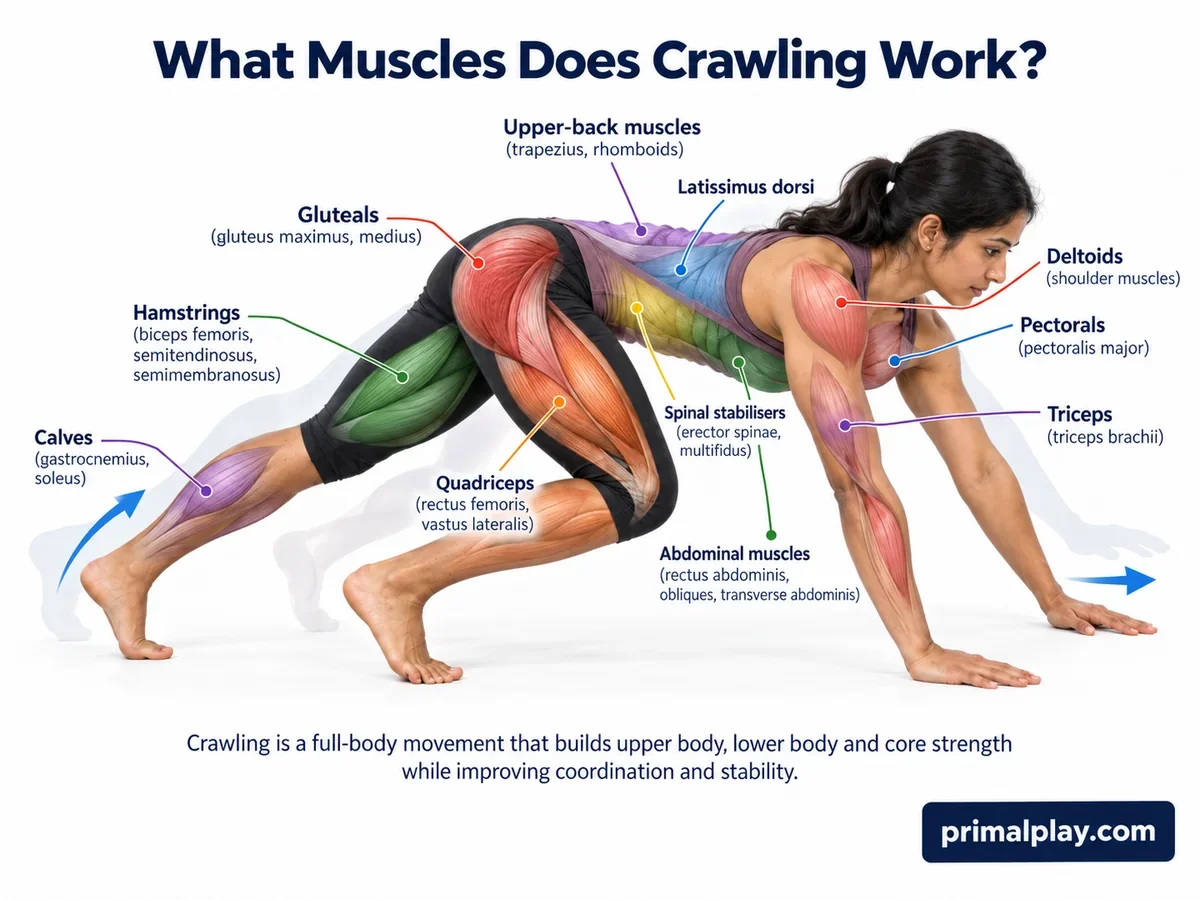
Educational muscle map showing an adult woman crawling, with major muscle groups labelled across the upper body, trunk and lower body, including the deltoids, pectorals, latissimus dorsi, triceps, abdominal muscles, spinal stabilisers, gluteals, quadriceps, hamstrings and calves.
Different crawling patterns change the emphasis. A low Bear Crawl usually increases the demand on the shoulders, arms and trunk, while longer steps and faster movement increase the contribution from the hips and legs.
For a full technique guide, see How to Do the Bear Crawl, Benefits and Variations.
What Are the Physical Benefits of Crawling?
Crawling combines muscular effort, joint control and coordinated movement in one exercise. Supporting your body on your hands and feet creates meaningful demand through the shoulders, arms, trunk, hips and legs, while stabilising muscles help control posture and movement.
Quadrupedal training has been associated with improvements in movement quality and active range of motion in small trials. [2] Crawling also challenges coordination because opposite limbs often move together in a contralateral pattern while the trunk resists unwanted rotation.
With appropriate progression, crawling can help develop shoulder and trunk control, coordination, mobility and confidence with weight-bearing movement. These qualities make it a useful addition to a broader strength and movement programme.
Does Crawling Have Benefits for the Brain?
Crawling gives your brain a complex movement problem to solve. You have to coordinate all four limbs, control your trunk, process sensory information, judge body position and continually adjust your movements as you travel.
Direct research on crawling and cognition in adults is still limited. One small randomised trial found that four weeks of progressive quadrupedal movement training improved several measures of cognitive flexibility in healthy young adults.[1]
The wider neuroscience is more compelling. Learning and practising complex motor skills engages networks involved in movement planning, sensory processing, error correction and motor learning. Research shows that motor-skill acquisition can produce functional and structural changes across the motor cortex, cerebellum, basal ganglia and associated networks. [6] This is one reason dancing provides significant cognitive benefits.
Crawling is particularly interesting because it combines coordination, balance, sensory feedback and continuous movement adaptation. These demands make it a plausible form of cognitively engaging physical activity. Research across exercise more broadly also shows benefits for cognition and executive function, with some evidence suggesting that coordinative forms of exercise may produce greater cognitive benefits than less coordinatively demanding activity.
This does not prove that crawling produces unique changes in the adult brain. It does provide a credible neuroscience rationale for using crawling as a movement task that challenges the brain and body at the same time.
Does Crawling Improve Coordination and Proprioception?
Crawling places a high demand on coordination because your arms and legs must work together while your trunk stabilises the body and your position changes with every step. Many crawling patterns use contralateral movement, where the opposite arm and leg move together, creating a continuous coordination challenge. [4]
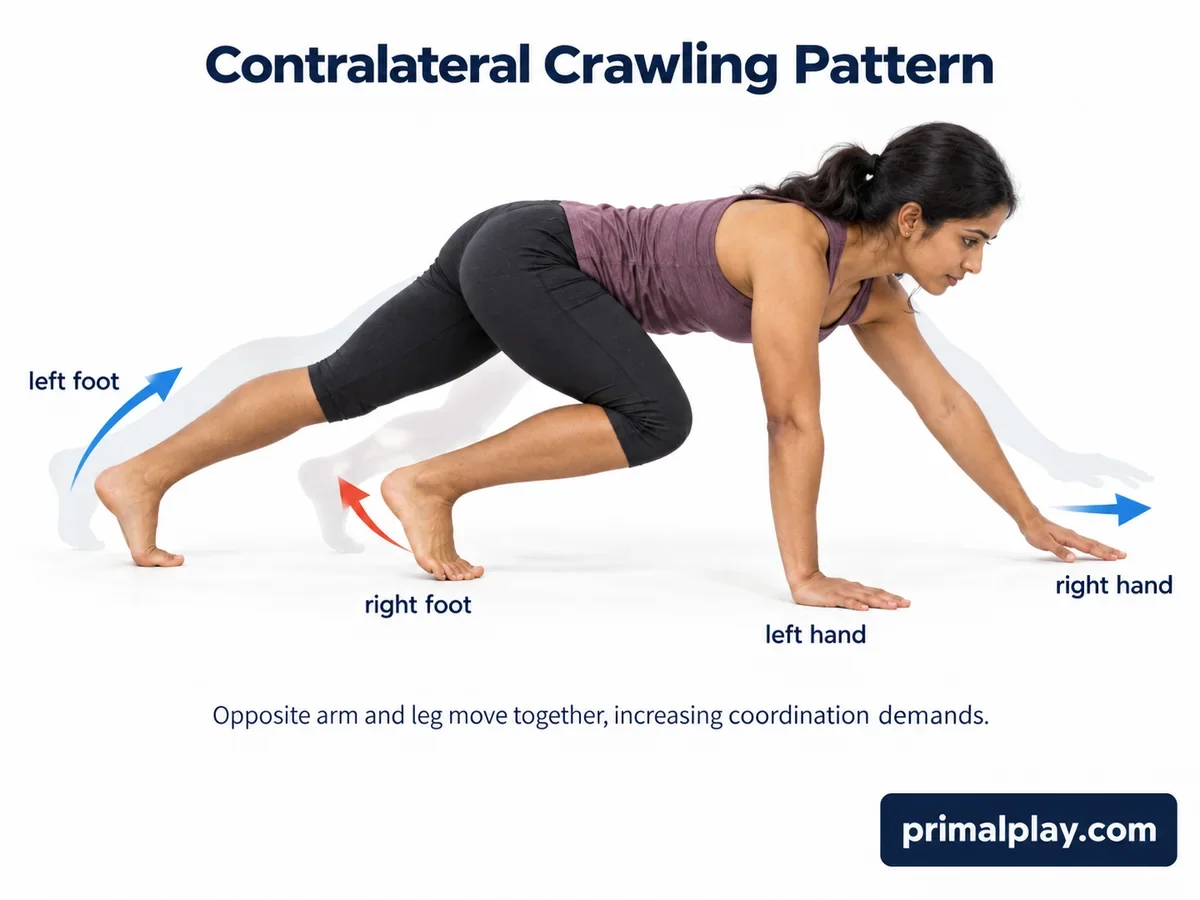
Contralateral crawling commonly pairs one arm with the opposite leg, increasing interlimb coordination demands. [4]
There is also some direct evidence for proprioception. In a small randomised trial, four weeks of progressive quadrupedal movement training improved joint-reposition sense at one tested shoulder angle. [1] This suggests that repeated crawling-style movement may improve your awareness and control of joint position, although the effect was specific and the evidence remains limited.
From a physiological perspective, this makes sense. Crawling continuously combines sensory feedback from the hands and feet with information from muscles, joints and the vestibular system. Your nervous system uses this information to organise posture, control limb placement and make rapid adjustments as you move.
Can Crawling Improve Mobility?
Crawling can challenge mobility because your shoulders and hips repeatedly move through changing positions while you support and move your body weight.
In a randomised trial of 42 active young adults, participants completed two 60-minute quadrupedal movement sessions each week for eight weeks. Compared with the control group, they improved active hip flexion, hip lateral rotation and shoulder extension. They also improved several Functional Movement Screen measures related to movement quality and whole-body stability.
These findings suggest that regular quadrupedal movement can help develop usable range of motion alongside control. That combination matters because mobility involves accessing movement and controlling it, rather than simply achieving a passive stretch.
The study did not find significant improvements in dynamic balance, handgrip strength or push-up endurance, so the clearest evidence from this trial supports active range of motion and movement quality. [2]
Is Crawling Used in Rehabilitation?
Yes. Crawling and other quadrupedal movements are used in some rehabilitation settings because they can challenge trunk control, balance, coordination and weight-bearing through the limbs.
A 2026 scoping review of quadrupedal-derived training after stroke identified 18 studies, including five randomised controlled trials. [5] The strongest and most consistent findings related to improvements in trunk control and balance, while effects on mobility and gait varied according to the exercise variation and training dose. No serious adverse events were reported in the studies that recorded safety outcomes.
There is a plausible rehabilitation rationale. Four-point support, kneeling, contralateral limb movements and crawling can require repeated postural adjustments, sensory feedback and coordinated loading through the trunk and limbs. Trunk control itself is an established rehabilitation target after stroke because it contributes to sitting, standing, balance and functional movement.
Rehabilitation applications should be selected and progressed according to the person's diagnosis, symptoms, capacity and clinical goals. Crawling should therefore be viewed as one possible rehabilitation tool rather than a substitute for clinical assessment or an individualised rehabilitation programme.
How Do You Start Crawling for Exercise?
Start in a comfortable hands-and-knees position, if it is appropriate for your joints, balance, and current capacity. If that feels manageable, progress to crawling with your knees lifted from the floor. From there, you can change the direction, distance, speed or duration as your coordination and strength improve.
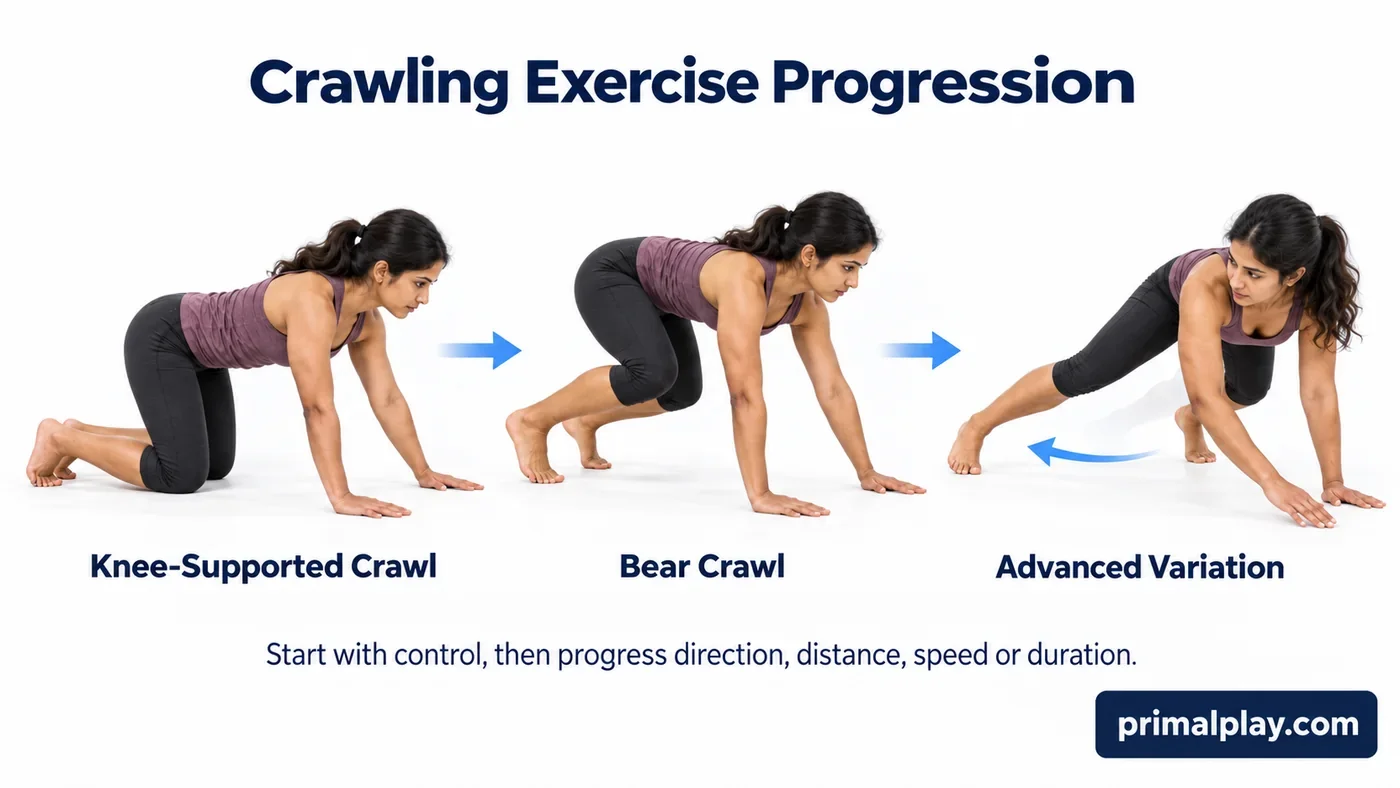
Start with a controlled knee-supported crawl, progress to a Bear Crawl with the knees lifted, then add more demanding variations by changing direction, distance, speed or duration.
For detailed technique, regressions, progressions and common mistakes, see How to Do the Bear Crawl, Benefits and Variations.
What Types of Crawling Exercises Can Adults Try?
Adults can try several crawling variations, each with a slightly different challenge.
The Bear Crawl uses the hands and feet with the knees lifted, creating a demanding whole-body pattern. A Crab Walk changes the body position and places more emphasis on the back of the shoulders, arms and hips. Backwards crawling increases the coordination challenge, while lateral crawling adds side-to-side movement. Knee-supported crawling offers a more accessible starting point when appropriate.
You can explore more crawling, ground-based movement and playful movement ideas in Primal Play in Practice.
Crawling can be simple, demanding and surprisingly adaptable. Your shoulders support you, your trunk controls you, your hips help drive you and your brain coordinates the movement. The evidence base is still developing, but current research supports quadrupedal movement as a useful way to challenge mobility, coordination, movement quality and whole-body control.
If you want to practise the movement itself, start with How to Do the Bear Crawl, Benefits and Variations. For more crawling, ground-based movement and playful movement ideas, explore Primal Play in Practice.
References:
Matthews MJ, Yusuf M, Doyle C, Thompson C. Quadrupedal movement training improves markers of cognition and joint repositioning. Hum Mov Sci. 2016;47:70-80. doi:10.1016/j.humov.2016.02.002.
Buxton JD, Prins PJ, Miller MG, et al. The effects of a novel quadrupedal movement training program on functional movement, range of motion, muscular strength, and endurance. J Strength Cond Res. 2022;36(8):2186-2193. doi:10.1519/JSC.0000000000003818.
Buxton J, Daugherty M, Grubbs R, et al. Comparison of muscle activation during quadrupedal movement training and traditional bodyweight exercises. J Bodyw Mov Ther. 2024;40:2173-2178. doi:10.1016/j.jbmt.2024.11.002.
Li C, Chen X, Zhang X, Wu D. Research on the electromyography-based pattern recognition for inter-limb coordination in human crawling motion. Front Neurosci. 2024;18:1349347. doi:10.3389/fnins.2024.1349347.
Kuipers JA, Carrick FR, Jemni M. Quadrupedal training approaches in post-stroke rehabilitation: a scoping review of evidence, mechanisms, and clinical applications. Front Syst Neurosci. 2026;20:1773330. doi:10.3389/fnsys.2026.1773330.
Dayan E, Cohen LG. Neuroplasticity subserving motor skill learning. Neuron. 2011;72(3):443-454. doi:10.1016/j.neuron.2011.10.008.
RECENT POSTS:
Evolutionary biology helps explain why human bodies developed the capacity for varied physical activity across different environments. In the Primal Play Method®, it explains why movement matters, the range of movement humans can perform, and how modern environments can reduce everyday physical activity.