
Bear Crawl: How to Do It, Benefits and Variations
Published: 25 May 2021
Last updated: 5 September 2026
WHAT IS THE BEAR CRAWL EXERCISE?
The Bear Crawl is a full-body quadrupedal movement performed on your hands and feet, with your knees held above the ground. Move the opposite hand and foot together while keeping your trunk controlled.
The exercise challenges whole-body strength, coordination, shoulder stability, trunk control and locomotion using only your bodyweight.
In the Primal Play Method®, Bear Crawls can be used as a movement skill, conditioning task or playful challenge. Changing the speed, distance, direction, surface, or rules creates a different physical and playful experience.
| Bear Crawl overview | Answer |
|---|---|
| Movement type | Contralateral quadrupedal locomotion |
| Main areas challenged | Shoulders, arms, trunk, hips and legs |
| Equipment | None |
| Difficulty | Adaptable from beginner to advanced |
| Beginner starting point | 5 to 10 controlled steps or 15 to 20 seconds |
| Easier option | Knee-supported four-point crawl |
| Harder options | Backwards, lateral, incline, resisted or faster crawling |
What does the Bear Crawl train?
Bear Crawls challenge multiple muscle groups across the upper body, trunk and lower body. They also require coordinated movement between opposite arms and legs.
Research on quadrupedal movement training suggests that these movements can produce moderate to high muscle activation across several upper-body and lower-body muscles. A small randomised trial also found improvements in cognitive flexibility and joint repositioning after four weeks of progressive quadrupedal training in healthy young adults.[1,2]
Faster or longer Bear Crawl sessions can also raise cardiovascular demand. The effect depends on your speed, duration, recovery and fitness level.
What muscles does the Bear Crawl use?
The Bear Crawl challenges the shoulders, chest, arms, back, trunk, hips and legs. Your shoulders and arms support and move the upper body. Your trunk muscles control rotation and help maintain position. Your hips and legs support the lower body and drive each step.
The muscular demand changes with your speed, body position, direction and any additional resistance.
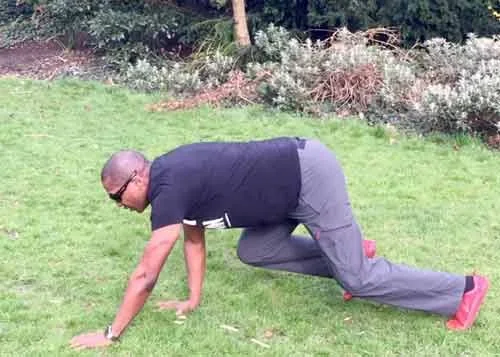
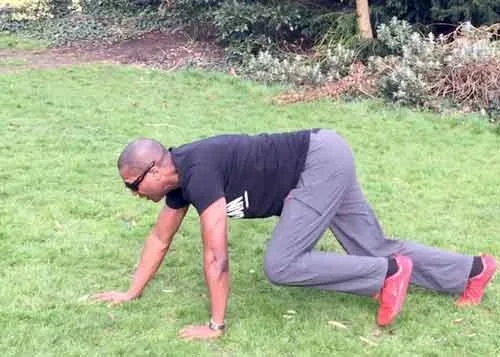
HOW TO DO THE BEAR CRAWL Step by Step
Begin on your hands and knees.
Position your hands beneath your shoulders and your knees beneath your hips.
Tuck your toes and lift your knees slightly above the floor.
Keep your back relatively flat and your trunk controlled.
Move your right hand and left foot forward together.
Repeat with your left hand and right foot.
Continue using small, controlled steps.
Keep your knees close to the floor. Stay light through your hands and feet. Limit excessive side-to-side movement through your hips.
Start with a short distance and a pace you can control. Reduce the speed, distance or duration when your technique begins to deteriorate.
Aim for stability.
Start with short distances and a pace you can control. Reduce the range, speed or duration if you lose trunk control or experience pain. Every time you move in this position, your body will naturally want to shift side-to-side, but you want to challenge your core to maintain a stable trunk position. More difficult than it sounds.
Move Animal, Think Human. Move with control and ease. Explore how the movement feels at different speeds and in different directions.
Bear Crawl Exercise Demonstration and Benefits
Common Bear Crawl Mistakes and how to Fix Them
| Common mistake | What to do |
|---|---|
| Hips rising too high | Keep your knees closer to the floor and shorten the set |
| Taking large steps | Use shorter hand and foot movements |
| Excessive hip rotation | Slow down and control your trunk |
| Looking too far forward | Keep your neck aligned with your spine |
| Knees repeatedly touching down | Reduce the distance or use the supported version |
| Increasing speed too early | Establish control before moving faster |
How can you make the Bear Crawl harder?
Here are several ideas to increase the intensity of the Bear Crawl exercise.
Once you feel comfortable with the basic movement, you can:
Crawl backwards.
Crawl sideways.
Move in slow motion.
Increase your speed while maintaining control.
Crawl uphill.
Add resistance with a weighted vest.
Add changes of direction.
Introduce reactions, rules or a partner.
The Treadmill Bear Crawl is an advanced, unconventional variation. Become confident with the floor-based version first.
How to Make the Bear Crawl Easier
Start with a four-point crawl while keeping your knees on the ground. This reduces the effort required to hold your knees above the floor while you learn the movement pattern.
You can also:
Reduce the distance.
Move more slowly.
Take smaller steps.
Practise holding the Bear Crawl position without travelling.
Rest whenever you lose control of the position.
Bear Crawl Variations
Standard Bear Crawl: Move forwards using opposite hands and feet.
Backwards Bear Crawl: Reverse the movement and direction.
Lateral Bear Crawl: Travel sideways while maintaining your position.
Slow-Motion Bear Crawl: Move as slowly and smoothly as possible.
Fast Bear Crawl: Increase your pace while retaining coordination.
Incline Bear Crawl: Travel uphill to increase the challenge.
Weighted Bear Crawl: Add resistance after developing consistent technique.
Treadmill Bear Crawl: An advanced equipment-based variation using a moving belt.
Bear Crawl Tag: Turn the movement into a reactive social game.
Each variation shifts the strength, coordination, conditioning or playful demand in a different way. Mixing them keeps the movement fresh and gives your body new challenges over time.
How to Use Bear Crawls in Your Training
| Purpose | Starting approach |
|---|---|
| Learn the movement | 5 to 10 slow, controlled steps |
| Warm-up | 10 to 20 controlled steps |
| Muscular endurance | 15 to 30 seconds followed by recovery |
| Coordination | Combine forward, backwards and lateral movement |
| Conditioning | Use short work periods with enough recovery to maintain technique |
| Active play | Add races, reactions, direction changes or Bear Crawl Tag |
How does the Bear Crawl fit into the Primal Play Method®?
The Bear Crawl is a foundational movement in the Primal Play Method®. It can be used for locomotion, strength, coordination, conditioning and games.
Changing the direction, speed, environment or rules transforms the same movement into a different physical and playful challenge.
This adaptability allows children to explore movement, adults to build fitness and older adults to practise strength and coordination at an appropriate level.
Explore more examples in Primal Play in Practice and Animal Moves.
Bear Crawl FAQs
Are Bear Crawls good for strength and cardio?
Bear Crawls can challenge muscular endurance, coordination and cardiovascular fitness. The effect depends on speed, duration, distance, resistance and recovery.
Why are Bear Crawls so hard?
Bear Crawls require your arms and legs to support and move your body while your trunk controls rotation. Several areas of the body work at the same time, which can make the movement feel demanding quickly.
Why do Bear Crawls hurt?
Bear Crawls should feel physically demanding. Pain is a reason to modify or stop. Wrist, shoulder, knee, hip or back discomfort may relate to your position, range, load or individual capacity. Reduce the distance, slow down, use the supported version or choose another movement.
How long should a beginner Bear Crawl?
Start with 5 to 10 controlled steps or 15 to 20 seconds. Rest fully and repeat only while you can maintain your position.
Can children do Bear Crawls?
Yes. Bear Crawls can be used in active play, physical education and movement-development activities. Keep the distance short and focus on exploration, control and enjoyment.
Are Bear Crawls suitable for older adults?
They can be adapted for some older adults. Suitability depends on the person’s ability to get down to and up from the floor, tolerate weight through the hands and maintain the position. Start with a supported version and adjust it to the individual. The movement supports independence and physical capacity in daily life, which aligns with the broader goals of active ageing through the Primal Play Method®.
How often can I include Bear Crawls?
Two or three times per week can be a reasonable starting point for many people. Frequency depends on the intensity, total training load and recovery.
Do Bear Crawls improve cognition?
A small study found improved cognitive flexibility after four weeks of progressive quadrupedal movement training in healthy young adults. The study examined a structured training programme that included several movements, so the findings cannot be attributed to Bear Crawls alone.[2] That said, the movement's coordination demands engage the brain in ways that simple, repetitive exercises often do not.
Can I do Bear Crawls at home?
Yes. You need a clear floor area and no equipment. You can crawl forwards and backwards over a short distance when space is limited. Carpet, grass or a padded surface can make the movement more comfortable for your hands and knees when you are starting out.
What is the difference between a Bear Crawl and a Crab Walk?
A Bear Crawl is performed face-down, moving on your hands and feet with your hips above the floor. A Crab Walk is performed face-up, with your hips lifted and your hands and feet on the floor. Both are quadrupedal movements that challenge the trunk, arms, and legs, but they work the body differently because of the change in body position and direction of load.
Written and demonstrated by Darryl Edwards, founder of the Primal Play Method®, author of Animal Moves, CIMSPA Chartered Fellow and exercise medicine practitioner.
References:
[1] Buxton J, Daugherty M, Grubbs R, et al. Comparison of muscle activation during quadrupedal movement training and traditional bodyweight exercises. J Bodyw Mov Ther. 2024;40:2173-2178. doi:10.1016/j.jbmt.2024.11.002
[2] Matthews MJ, Yusuf M, Doyle C, Thompson C. Quadrupedal movement training improves markers of cognition and joint repositioning. Hum Mov Sci. 2016;47:70-80. doi:10.1016/j.humov.2016.02.002.
RELATED: Try a Bear Crawl on a Treadmill
RELATED POSTS:
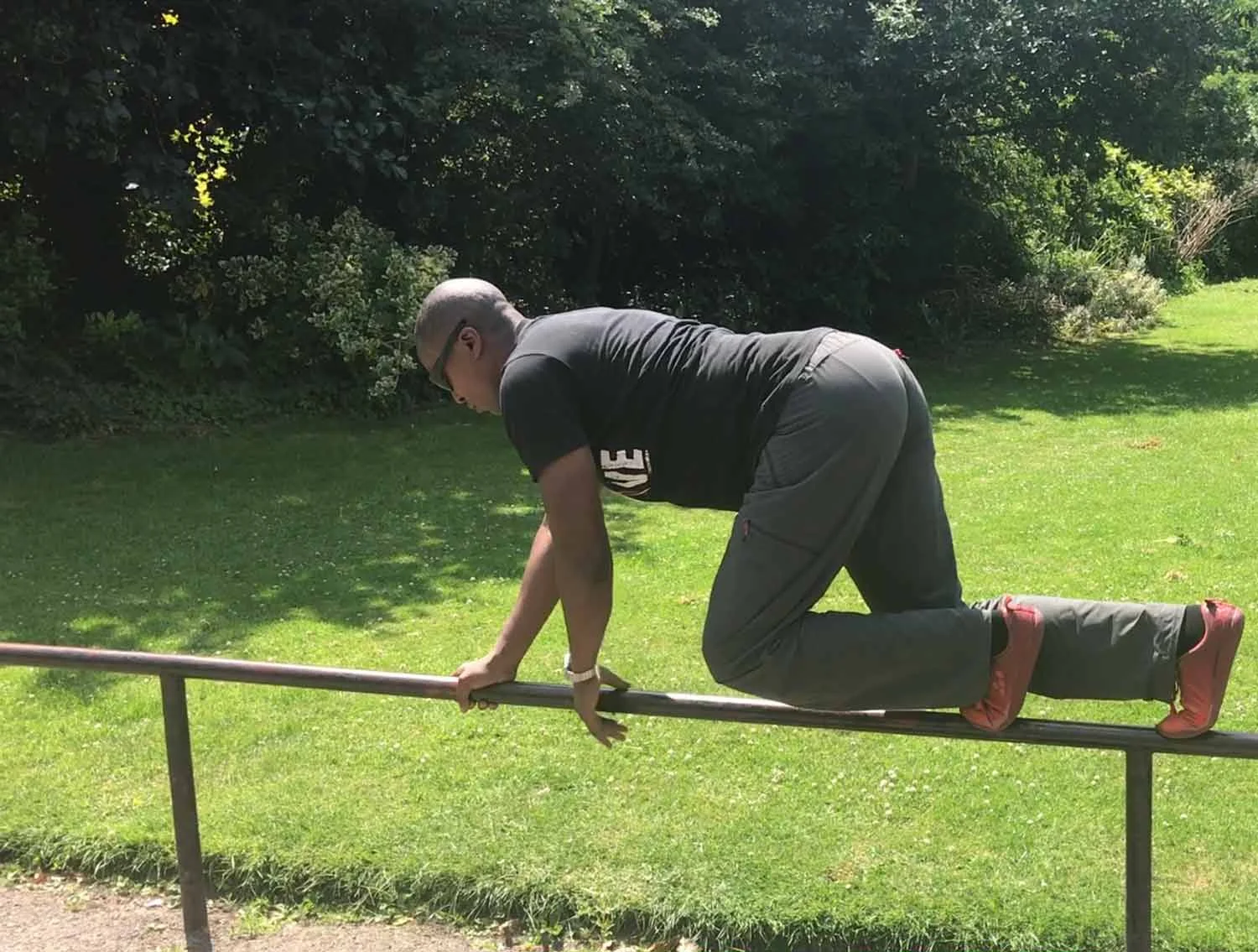





Learn how to perform the Treadmill Bear Crawl, how to approach it safely, and how to progress this unconventional quadrupedal movement challenge.