

Rediscover the Joy of Movement Through Natural Play
““The power of primal active play lies in its simplicity, move often, move naturally, and enjoy being human.””
Being childlike with activity not childish.
Remember when you were a child and movement wasn't something you scheduled or dreaded? You didn't need a gym membership or a fitness tracker to get you moving. You simply played, climbed, ran, and explored because it felt good. That innate connection to movement is still within you, waiting to be rediscovered. When we strip away the obligation and reconnect with our natural instincts, we can experience the joy of movement in ways that transform our relationship with physical activity entirely.
Why Traditional Exercise Often Falls Short
You've probably been there. You sign up for a gym membership in January, attend religiously for three weeks, then gradually fade away as the novelty wears off. It's not because you're lazy or lack discipline. The problem runs deeper than that.
Traditional exercise approaches often focus exclusively on outcomes: burning calories, building muscle, or hitting arbitrary step counts. Whilst these goals have their place, they turn movement into a transaction rather than an experience. You're essentially bargaining with your body, forcing it to comply with routines that feel more like punishment than pleasure.
The Missing Element in Modern Fitness
What's missing is the element that made movement irresistible when you were young: play. Children don't exercise; they explore, experiment, and express themselves through their bodies. They experience the joy of movement without even realising they're getting fitter or stronger.
Research supports what we instinctively know. Studies on traditional sporting games in elementary education demonstrate that playful activities evoke significantly more positive emotions than structured exercise programmes. When movement feels like play rather than work, your brain releases different neurochemicals, creating associations of pleasure rather than dread.

From treadmill routine to playful exploration, movement becomes easier to sustain when it feels natural, enjoyable, and part of everyday life.
Reclaiming Your Natural Movement Vocabulary
Your body was designed for a rich variety of movements. Crawling, climbing, balancing, jumping, throwing, catching, lifting, carrying. These aren't just exercises; they're fundamental human movement patterns that our ancestors used daily for survival and recreation.
Modern life has narrowed our movement vocabulary dramatically. You might walk, sit, and occasionally run on a treadmill, but when was the last time you:
Climbed a tree or scrambled over rocks?
Crawled on all fours like you did as a toddler?
Balanced along a low wall or log?
Threw or caught something just for the fun of it?
Rolled down a hill?
These primal movements aren't childish; they're essential components of how your body wants to move. Incorporating them back into your life can unlock significant benefits for balance and coordination whilst simultaneously reigniting that sense of physical joy you might have forgotten.
Building a Diverse Movement Practice
Think of movement like your diet. You wouldn't eat only one food group and expect optimal health. Similarly, limiting yourself to one or two types of exercise leaves massive gaps in your physical capabilities.
| Movement Pattern | Traditional Exercise | Playful Alternative |
|---|---|---|
| Locomotion | Treadmill running | Tag games, obstacle courses |
| Upper body push | Bench press | Handstands, partner games |
| Upper body pull | Lat pulldown | Climbing, hanging games |
| Ground movement | Burpees | Animal walks, crawling races |
| Balance | Bosu ball | Slacklining, tree balancing |
The playful alternatives engage your mind and body simultaneously. They require problem-solving, spatial awareness, and adaptation, creating a richer movement experience that builds both physical and cognitive capabilities.
The Psychology Behind Movement and Joy
Why does playful movement feel so different from traditional exercise? The answer lies in how your brain processes the experience. When you're genuinely enjoying an activity, you enter a state of flow where time seems to disappear and effort feels effortless.
Finding joyful movement, as health experts increasingly recognise, isn't about finding the "best" workout. It's about discovering activities that align with your personality, preferences, and current life circumstances. For some people, that might be dancing. For others, it could be martial arts, parkour, or simply playing with their children or grandchildren.
The Neuroscience of Play and Movement
Your brain doesn't distinguish between "proper exercise" and playful movement when it comes to physical benefits. However, it absolutely recognises the difference in emotional context. Play activates your brain's reward centres more intensely than obligation-based exercise, creating positive feedback loops that make you want to move more.
Research on the mental health benefits of exercise consistently shows that the psychological benefits extend far beyond simple endorphin release. When movement is joyful, it reduces cortisol, improves sleep quality, enhances creativity, and builds resilience against stress.
Key psychological benefits of playful movement include:
Reduced anxiety and depression symptoms
Improved self-confidence and body image
Enhanced cognitive function and memory
Greater emotional regulation
Increased social connection when done with others
Better stress management capabilities
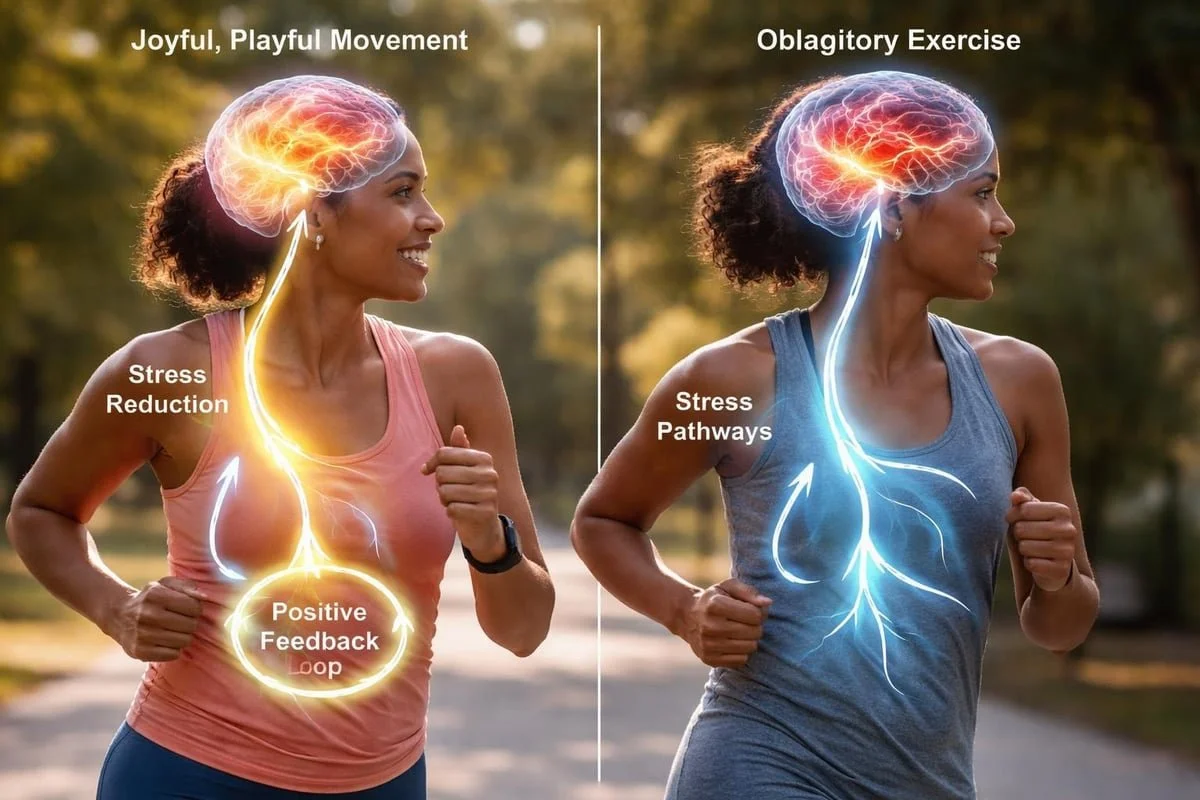
Joy changes the movement experience. When physical activity feels playful, rewarding, and self-directed, it can support a more positive stress response and a stronger desire to keep moving.
Creating Your Personal Movement Practice
You don't need to abandon all structure or goals to embrace the joy of movement. The key is reframing your approach to prioritise enjoyment alongside outcomes. Start by asking yourself different questions about movement.
Instead of "How many calories will this burn?" try asking:
What sounds fun today?
How does my body want to move right now?
What movement would feel like play rather than work?
Starting Small and Building Momentum
If you've spent years viewing exercise as a chore, shifting to a playful mindset won't happen overnight. That's perfectly fine. Begin by introducing small elements of play into activities you already do.
Progressive steps to rediscover movement joy:
Week 1-2: Add five minutes of playful movement to your existing routine (try animal walks or balance challenges)
Week 3-4: Dedicate one full session per week to pure play (no tracking, no goals, just exploration)
Week 5-6: Experiment with movement in new environments (parks, beaches, forests)
Week 7-8: Invite others to join you in playful movement activities
Ongoing: Gradually increase the play-to-exercise ratio based on what feels sustainable and enjoyable
The concept of rediscovering movement joy emphasises that this journey is personal. What brings you joy might bore someone else completely, and that's not only acceptable but expected. Your movement practice should reflect your unique preferences and circumstances.
Movement as Social Connection
One of the most powerful aspects of the joy of movement is its capacity to connect us with others. Whilst solo movement has its place, shared physical experiences create bonds that sedentary socialising simply cannot replicate.
Think about the difference between sitting in a coffee shop with friends versus hiking together, playing a sport, or dancing. The shared physical experience creates a different quality of connection. You're not just exchanging words; you're coordinating movements, solving physical challenges together, and creating shared memories rooted in bodily experience.
The Power of Collective Movement
Group activities amplify the joy of movement through what researchers call "collective effervescence." When you move in synchrony with others, whether through dance, team sports, or group fitness classes, your nervous system literally synchronises with those around you.
This phenomenon explains why collective physical activities strengthen social bonds so effectively. Your brain interprets shared movement as a sign of tribal belonging, triggering the release of oxytocin and other bonding neurochemicals.
Ways to incorporate social movement into your life:
Organise regular play sessions with friends or family
Join movement-based communities rather than traditional gyms
Create walking meetings instead of sitting in conference rooms
Attend workshops or classes focused on playful movement exploration
Participate in outdoor group activities like hiking clubs or adventure races
Adapting Movement Across Life Stages
The beautiful thing about embracing the joy of movement is that it remains accessible throughout your entire lifespan. Unlike performance-focused fitness, which often peaks in youth and declines with age, playful movement adapts to your changing capabilities and circumstances.
As a child, you might have loved hanging from monkey bars and doing cartwheels. In your twenties, perhaps you enjoyed more intense activities like rock climbing or martial arts. In your forties or fifties, you might find joy in activities that blend challenge with mindfulness, like yoga or tai chi. And in your later years, gentle movement exploration and balance work can provide both physical benefits and genuine pleasure.
Honouring Your Current Capabilities
One of the pitfalls of traditional fitness culture is its tendency to measure you against external standards or your younger self. This creates a recipe for disappointment and frustration. The playful movement approach asks a different question: What can your body do right now, and how can you explore that with curiosity and joy?
| Life Stage | Movement Focus | Playful Approaches |
|---|---|---|
| Children | Skill development, exploration | Free play, games, climbing |
| Young adults | Peak performance, challenge | Sports, adventure activities, dance |
| Middle age | Maintaining capability, stress relief | Group activities, outdoor pursuits, movement variety |
| Older adults | Balance, coordination, social connection | Gentle games, nature walks, partner activities |
Whatever your current age or fitness level, the principles remain constant. Move in ways that bring you joy, challenge you appropriately, and connect you with your body's innate wisdom.

The joy of movement spans the whole lifespan, from childhood play to adult adventure and active ageing, turning physical activity into something social, meaningful, and easier to sustain.
Overcoming Common Barriers to Joyful Movement
You might be thinking, "This sounds wonderful, but I don't have time for play." Or perhaps, "I'm too out of shape to start." These concerns are valid, but they often stem from the same limiting beliefs that make traditional exercise feel impossible.
The joy of movement doesn't require large time commitments or advanced fitness levels. In fact, one of its greatest advantages is its accessibility. You can play for five minutes or five hours. You can explore movement in your living room or venture into nature. There's no minimum entry requirement beyond a willingness to experiment.
Addressing the Time Constraint
The "I don't have time" barrier usually reflects priorities rather than actual time availability. When movement is genuinely enjoyable, you don't need to find time; you want to make time. It becomes recreation rather than obligation.
Consider these time-efficient approaches:
Movement snacking: Three five-minute play breaks throughout your day provide similar benefits to one 15-minute session
Active commuting: Turn your journey to work into an opportunity for joyful movement
Social movement: Replace some sedentary social time with active alternatives
Integrated play: Involve children or grandchildren in movement activities you'd be doing anyway
Dealing with Self-Consciousness
Many adults feel embarrassed about playing. You might worry about looking silly or childish. This self-consciousness is a significant barrier, but it reveals something important: you care more about external judgement than internal experience.
The truth is, most people are too focused on their own lives to judge yours. And those who do judge someone for moving joyfully? Their opinion probably isn't worth considering anyway. Exploring why active play benefits adults reveals that the rewards far outweigh any temporary discomfort about appearing unconventional.
The Environmental Dimension of Movement
Where you move matters almost as much as how you move. Whilst you can certainly experience the joy of movement indoors, there's something uniquely powerful about connecting with nature whilst exploring your physical capabilities.
Natural environments provide constantly changing terrain, varied surfaces, and unpredictable challenges that indoor settings cannot replicate. A tree branch becomes a balance beam. A boulder becomes a climbing challenge. A hill becomes an opportunity for rolling, sprinting, or simply appreciating the view from the top.
Bringing Movement Outdoors
Even if you live in an urban area, opportunities for outdoor movement abound. Parks, playgrounds (yes, adult bodies can use them too), walking trails, and even interesting architecture can provide stimulus for playful exploration.
Studies on outdoor play benefits demonstrate advantages that extend beyond the physical. Natural light improves mood and circadian rhythms. Fresh air enhances respiratory function. Natural surfaces provide varied proprioceptive feedback that improves balance and coordination.
Outdoor movement ideas for adults:
Forest bathing combined with movement exploration
Beach activities: running, jumping, building, playing
Urban exploration: finding new routes, stairs, interesting features
Park workouts: using natural equipment like logs and branches
Trail activities: hiking with playful elements like balancing on fallen trees
Measuring Success Differently
Traditional fitness culture teaches you to measure success through numbers: kilograms lost, kilometres run, calories burned. Whilst data has its place, these metrics often fail to capture what truly matters about movement.
When you embrace the joy of movement, success looks different. It's measured in smiles, in time that passed without checking the clock, in new capabilities discovered, in stress melted away, in connections deepened with others.
Creating New Success Markers
How do you know if your movement practice is working when you're not obsessively tracking numbers? Trust your subjective experience:
Do you look forward to moving rather than dreading it?
Do you feel energised rather than depleted afterwards?
Are you sleeping better?
Do you feel more capable in daily life?
Are you discovering new things about your body's abilities?
Do you feel more connected to yourself and others?
These qualitative markers often predict long-term adherence better than quantitative measures. When movement feels good, you keep doing it. When it feels like punishment, you eventually quit, regardless of how impressive your progress charts look.
| Traditional Success Metrics | Joyful Movement Metrics |
|---|---|
| Weight lost | Energy levels |
| Calories burned | Quality of sleep |
| Minutes exercised | Mood improvements |
| Personal records | Enjoyment ratings |
| Body measurements | Consistency over time |
| Performance benchmarks | Variety of movements explored |
Building a Sustainable Movement Life
The ultimate goal isn't to experience the joy of movement occasionally; it's to build a life where joyful movement is woven into the fabric of your daily existence. This doesn't mean every movement session will feel ecstatic or every day will include profound physical experiences. It means that, overall, your relationship with movement is characterised by pleasure rather than punishment.
Sustainability requires flexibility. Some weeks you'll move more, some less. Some seasons favour outdoor activities, others indoor exploration. Some life phases support vigorous challenge, others call for gentler approaches. The playful movement mindset adapts to these changing circumstances rather than fighting against them.
Long-Term Strategies for Movement Joy
Building sustainable practices requires attention to both physical and psychological factors. Physically, you need sufficient variety to prevent both overuse injuries and boredom. Psychologically, you need enough autonomy to maintain intrinsic motivation whilst having enough structure to build consistent habits.
Consider these long-term sustainability principles:
Rotate activities regularly: Change your movement menu seasonally or monthly to maintain novelty
Listen to your body: Honour what feels good versus what you think you "should" do
Build community: Connect with others who share a playful movement philosophy
Embrace progression: Allow your practice to evolve as you discover new interests and capabilities
Release perfection: Some movement is always better than no movement, regardless of how "optimal" it is
Understanding why working out isn't working out helps you avoid the common pitfalls that derail traditional fitness approaches. The joy of movement sidesteps these traps by fundamentally reframing what movement is for: not punishment for eating, not obligation to meet arbitrary standards, but celebration of what your amazing body can do.
Rediscovering the joy of movement transforms your relationship with physical activity from obligation to opportunity, from dread to delight. When you approach movement with curiosity, playfulness, and genuine enjoyment, consistency becomes natural rather than forced. If you're ready to explore this playful approach to movement and health, Primal Play offers resources to help you reclaim your body's natural desire to move joyfully. Your younger self knew how to play; it's time to remember.
Unlock the secrets to a joyful and active life now! Download our FREE Importance of Play and Animal Moves Sampler eBooks. Dive into the world of play today and transform your routine with fun and movement. Don't miss out—your journey to a more playful life is just a click away!
RELATED POSTS:


How can we get more movement into our workday without having to hit the gym?